Author: admin

The Bodies

Installation
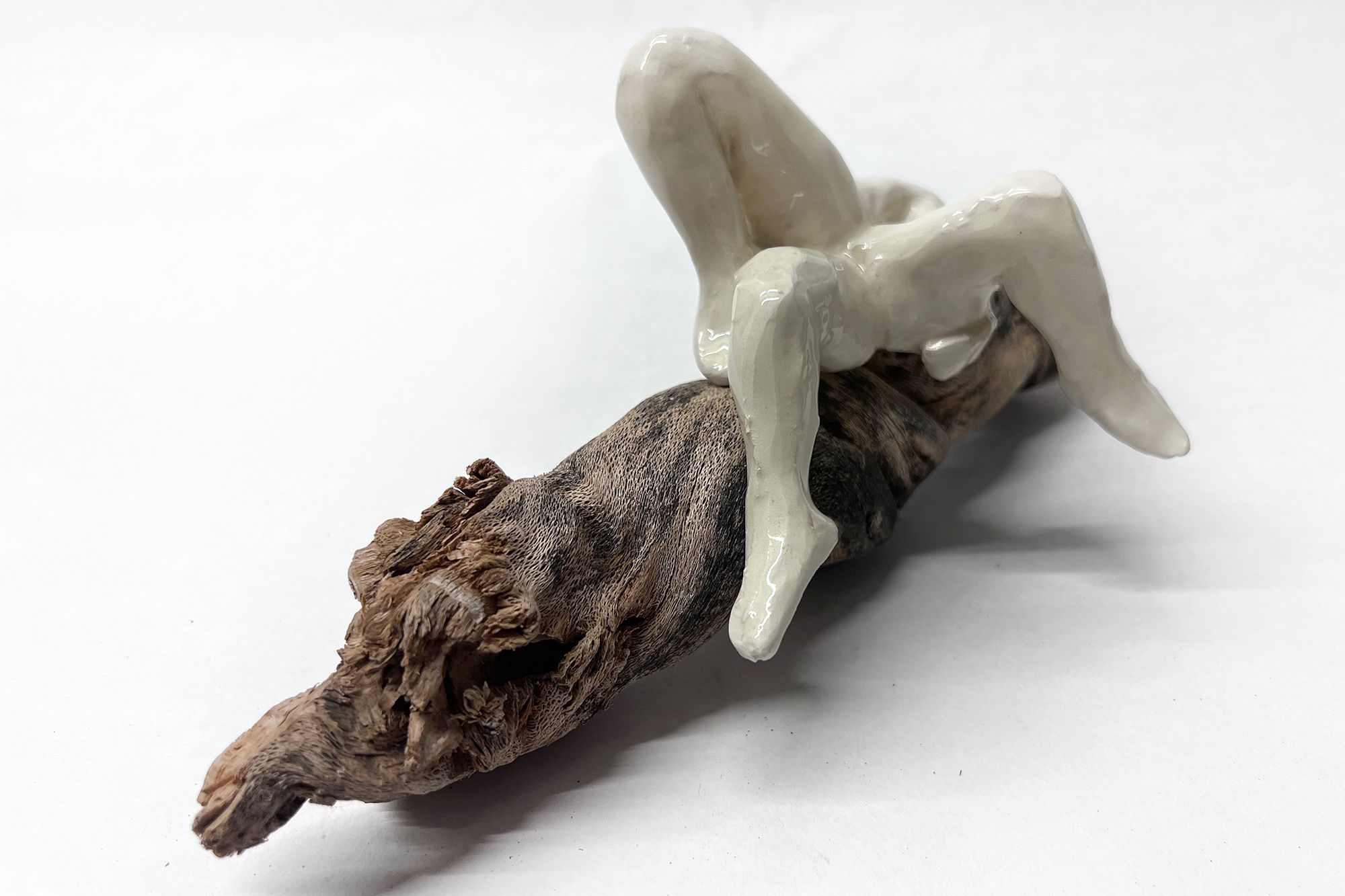
7 ceramic pieces + bones + branches + golden thread
Variable dimensions
2023

“The patriarchy does to our bodies
what extractivist and capitalist economies do
to our territories.”
—XIII Latin American and Caribbean Feminist Meeting, Peru, 2014*


Ceramic pieces of bodies in the process of transformation. Women’s bodies made of clay. Bodies that intertwine and engage in dialogue with branches and bones. Tied bodies. Bodies that pass through the fire of burning.
I propose delving into the concept of body-territory, as suggested by Lorena Cabnal**, who states, “…the notion of the body-territory allows us to connect different types of violence—patriarchal, colonial, and extractivist. At the same time, the defense of bodies and territories opens the collective space of healing, in the pursuit of breaking the colonial and patriarchal paradigm.”
I draw upon Rita Segato*** regarding the existence of an “archaic war,” often described in myths, where “the woman and her body-territory end up being taken, subdued, and expropriated of their sovereignty.”
*Institutional text from the XIII Latin American and Caribbean Feminist Meeting, held in Peru in 2014.
**Lorena Cabnal is a Guatemalan activist, co-founder of the community-territorial feminist movement in Guatemala, and of the Network of Ancestral Healers of Community Feminism.
***Rita Segato is a writer, thinker, anthropologist, and feminist activist, born in Buenos Aires, Argentina. A great scholar of macho violence and femicides, she gained recognition as an international reference voice on these topics and as an indispensable feminist thinker of our era.
The Scream

Installation
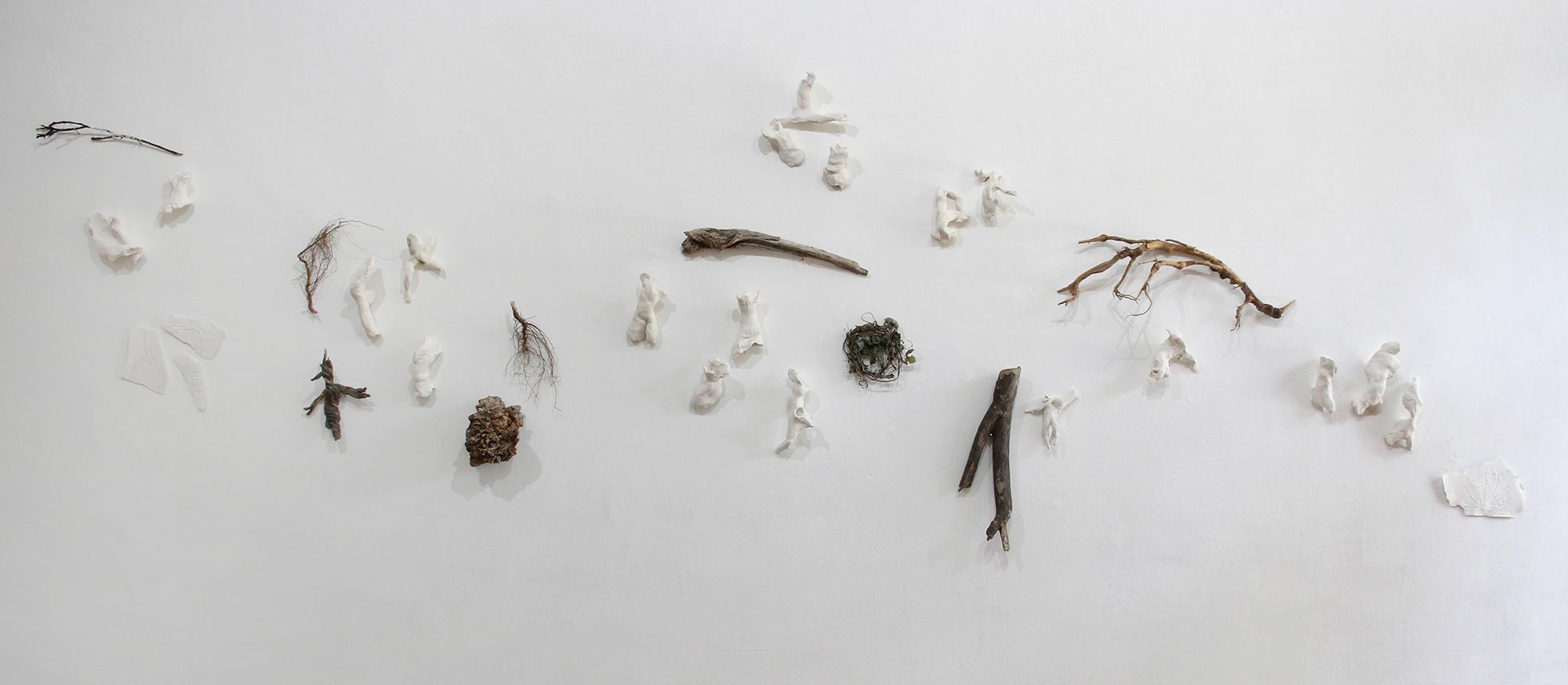
Ceramic pieces + tree branches + handmade embossed and intervened paper
200 x 160 cm

I explore other ways of screaming, of denouncing the pain historically endured by feminized bodies and halting systematic abuse. As Maristella Svampa writes, “…it is women who, above all, lead the resistance to deforestation, who place their bodies in front of bulldozers and denounce the contamination caused by agrochemicals. They are also the ones who have strengthened the commitment to a peasant-indigenous, social, and solidarity-based economy.”*

On a wall, I build this installation with ceramic pieces, tree branches of different types and shapes, plant elements, and embossed paper. In those torn pieces of paper with grooves of branches like veins, I intervene with parts of the myth told by Ovid in Metamorphoses.

Written in tiny letters that make reading difficult, they invite the viewer to come closer. At times, the text transforms into drawings. In the proximity needed for reading, the different aromas of the natural objects come through.

Suffocated screams, fragmented screams, screams in bodies, screams in the forest. Screams as denunciation, screams as healing.

*Maristella Svampa, Ecofeminismos territoriales en América Latina

70º | 275º

Installation
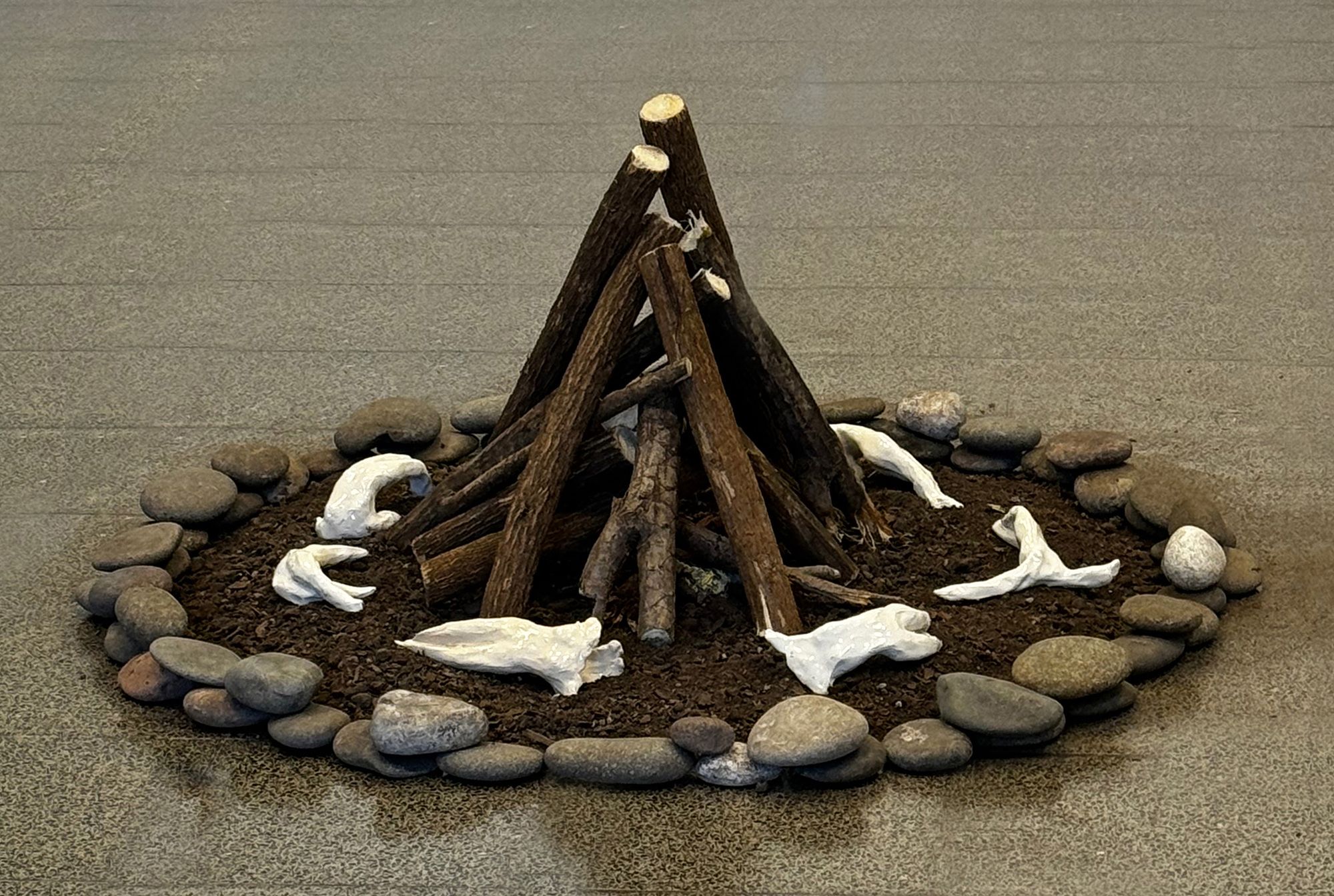
Earth + branches + ceramic pieces + river stones + lavender essence
120 cm in diameter
2024

A bonfire of sawn branches. A ritual round of women. A circle of stones. The earth that overflows. Earth, branches, medicinal herbs, and ceramic pieces as symbols of a society disconnected from nature—one that harms what it creates.

I draw upon the ritual circles of women, inheritors of ancestral wisdom. Seven bodies metamorphosing, twisting in constant transformation. Seven, like a cycle, like the phases of the moon, like the days of the week. Bringing into dialogue the violence suffered by bodies and by the territories where women are denied deep knowledge of their own habitat.

In her book Revolution at Point Zero, Silvia Federici states that “around the world, women have led the struggles against commercial logging and for the protection and reforestation of forests…” It is women’s bodies that remain exposed in the defense of harmony with what exists. Thus, I take 70º—the temperature at which human skin burns irreversibly—and 275º—the temperature at which wood ignites—referencing the deliberate burning of forests.

The Daphnes

“…she still feels her heart tremble
beneath the new bark,
and embracing those branches
as if they were limbs…”
—Metamorphoses, Publius Ovidius Naso

The Daphnes is a series composed of three works: The Bodies, The Scream, and 70º | 275º, all inspired by the Greek myth of Daphne and Apollo. In Metamorphoses, Ovid recounts how Daphne, daughter of the river and the earth, is relentlessly pursued by Apollo, who refuses to accept her rejection. Desperate, she transforms into a laurel tree.

The works evoke that moment of transformation—skin becoming bark. Dying and being reborn as a tree. Through these pieces, merging the fire arts with elements of nature, I suggest a connection between violence against women and the devastation of the environment.

In all three works, I explore the concept of interdependence as proposed by Judith Butler: “We are not individuals who become social through a contract; we are interdependent from the very beginning, and that interdependence is a constitutive feature of who we are…”

Cusco Refuge

Installation
Variable dimensions
Cusco, Perú 2024

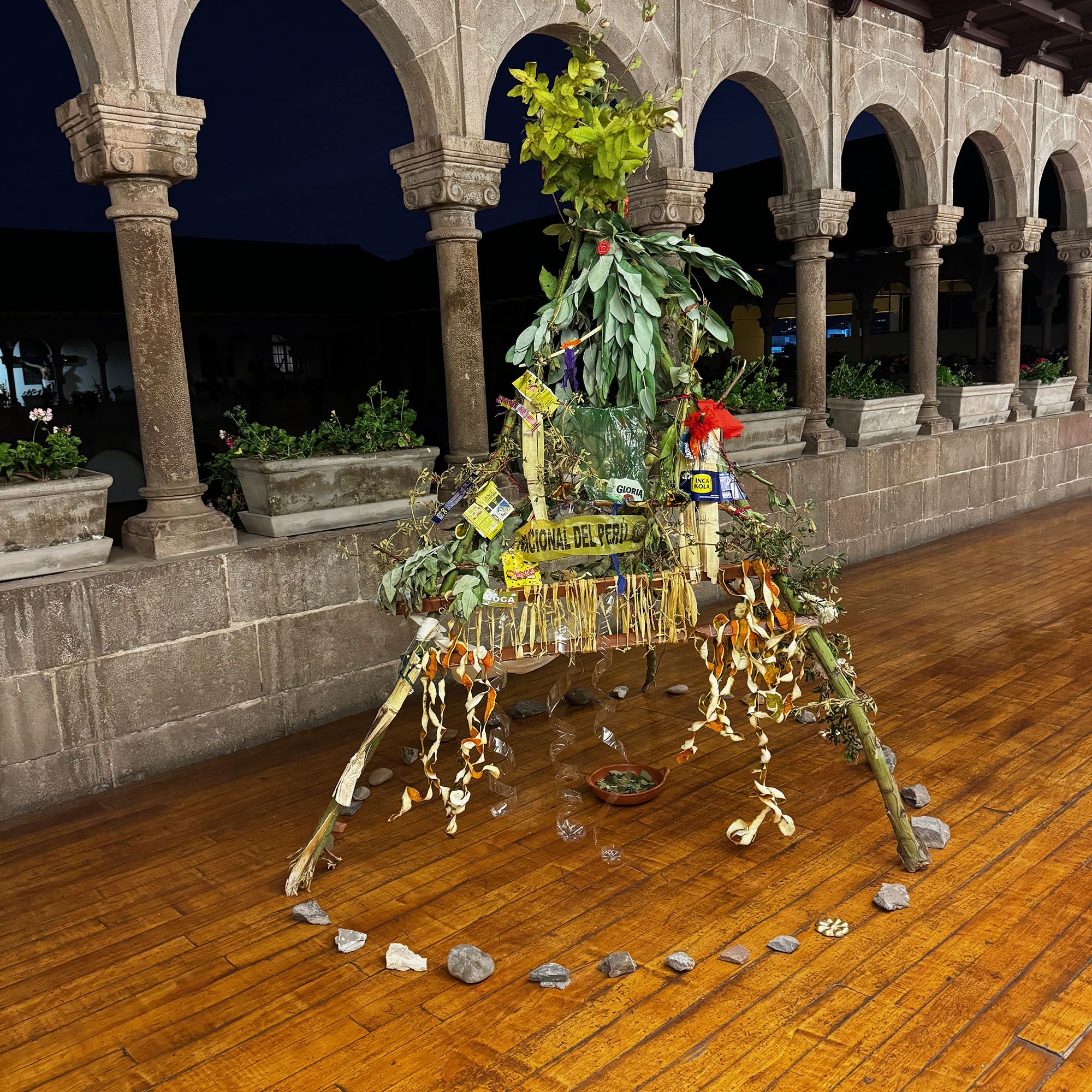
A refuge built in the Qorikancha Museum

I build an urban shelter, a protective space within the museum, which becomes a space-territory and also a home.

I walk through Cusco, wandering the streets aimlessly, with gloves and bags, my gaze mostly directed towards the ground. I collect what the city’s inhabitants discard, forget, or abandon. The smells overwhelm me.

Three eucalyptus branches support the structure, along with several branches of Queñoa, Chilca, and Aguaymanto, all local plants with various healing properties. I weave in a worn plastic tape that reads “NACIONAL DEL PERÚ,” a bottle label that says “ORO,” alongside another one from INCA COLA (*), technological discards, a green bag, commonly used to hold coca leaves, here containing part of a Gloria milk carton (**).
Several orange peels, typical of Cusco’s urban landscape, intertwine and add a particular scent of daily life in the city.

(*) A beverage born in Peru in 1939, now owned by Coca Cola.
(**) In the Cantuna Massacre – the exhumed bodies of the Peruvian students and teacher were packed by the state in Gloria milk cartons to send them to their respective families.

Santa Cruz Refuge

Installation
Object + video
Variable measures
Santa Cruz de la Sierra, Bolivia. 2024
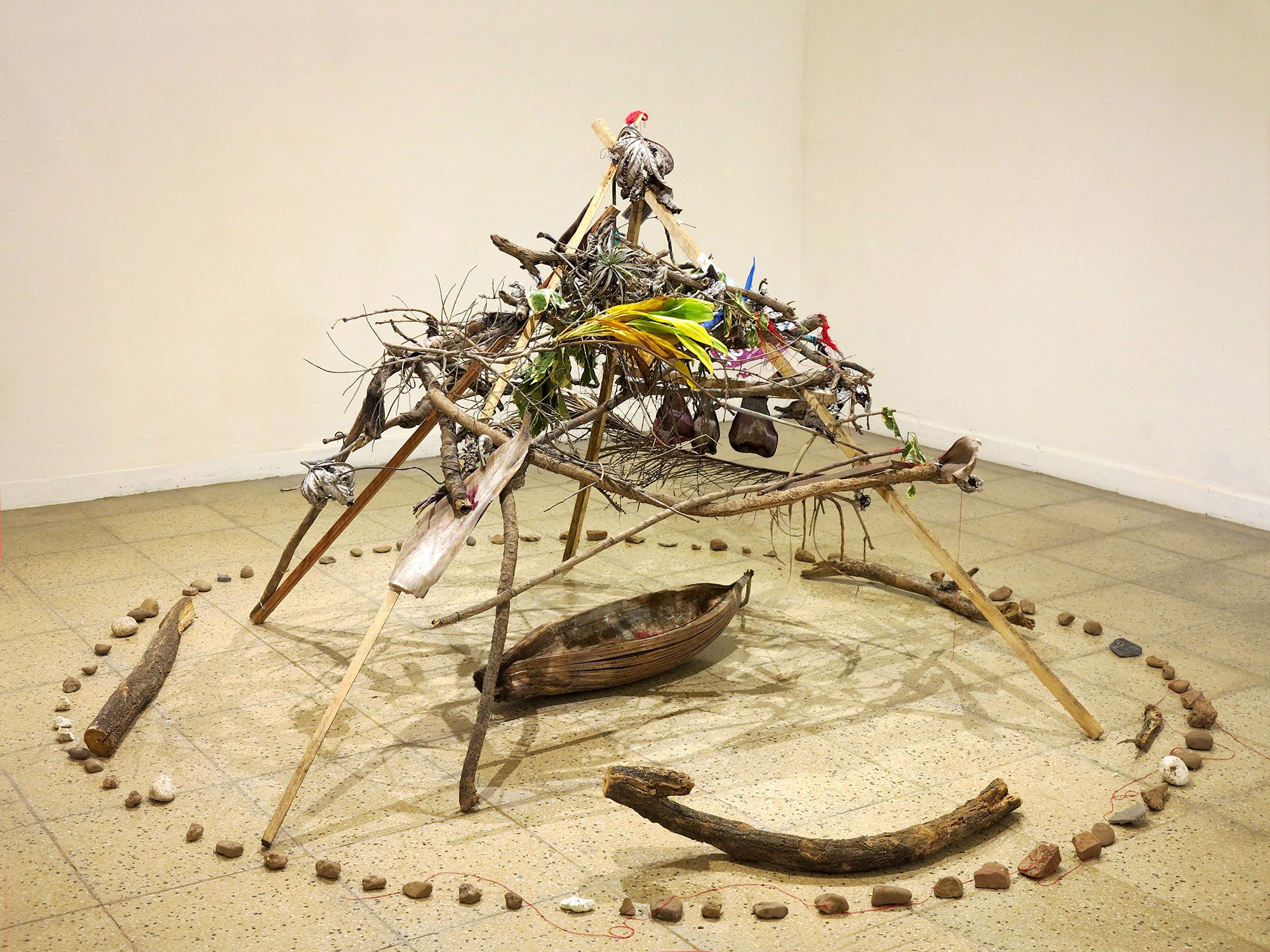
Refuge built in the Museum of Contemporary Art

I travel through Santa Cruz de la Sierra, I recognize myself in it. It is my first approach to the work and my first visit to this city, which I find more globalized than I expected. In the huge Mercado Mutualista, I buy my first cart and the bags that will accompany me throughout this experience.

My journeys become increasingly intense, the smells and the gazes on the street overwhelm me.

In the Museum space, I begin the construction with what I have collected. First, I delimit my territory by taking up the circle of stones I have been using since 2020.

Trash has texts, trash also speaks. A cardboard with the brand of feminine hygiene towels Nosotras (founded in Colombia, sold throughout Latin America) appears alongside a Coca Machucada container from the brand El Tóxico. A plastic bag with the Eco brand logo and a sun from a bag of potato chips, part of a frozen potato container by Simplot (which supplies brands like McDonalds and Burger King around the world).

Branches and construction wood form the structure that holds it, and I intertwine them with parts of local plants like Paichachi, along with some Air Plant in bloom. In the center, a kind of receptacle bowl, part of a Pindá palm bark, very typical of Santa Cruz.

If a were my home

I travel through the cities, I recognize myself in them. I choose and collect organic and inorganic objects. I build an urban refuge, weaving with the materials found in the city. Entangling, stitching the outside into the inside.

The utopian idea of progress presented by modernity slips away until it disappears in this new dystopian reality, from where we ask ourselves what the refuge is and what otherness represents. In this present, the outside, the other, is a threat. The refuge embraces you when you are in danger.

This project is constantly evolving; so far, it has been carried out at the Museum of Contemporary Art in Santa Cruz de la Sierra and at the Qorikancha Museum in Cusco.

The calling

Sound Installation.
Sound piece: 5:04’
Stones, branches, lavender, and zafu
2022 CABA

Suddenly, I am wounded…
And my heart stops,
My hair coils,
My shoulders expand,
Oh, my fingers bloom,
My limbs sprout wings,
I am going to drown
In lights and fragrances…
For in the midst of the jungle,
Your sweet voice calls me…
—Alfonsina Storni, The Call (excerpt)


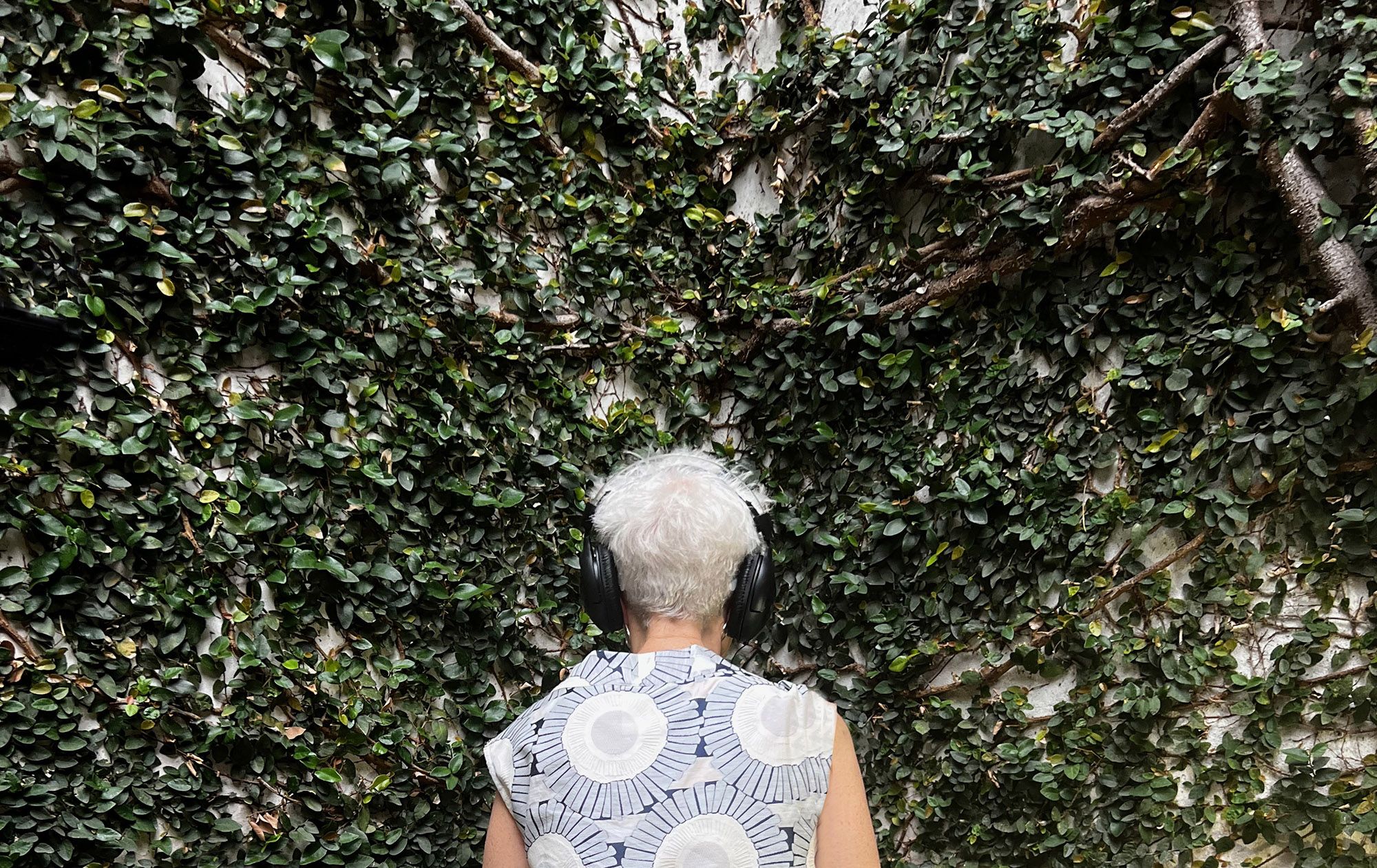
A circle of stones, an instruction on the wall inviting visitors to sit on the zafu and experience the sound of The Calling – a sonic piece composed of the creaking of branches in the Valdivian forest of Patagonia, Argentina, intertwined with a reading of Alfonsina Storni’s poem of the same name. Like asemic writing, the poem’s text dissolves through technological processing, transforming into ghosts and presences.

I propose a moment of introspection, a meditation to foster an internal experience—a personal journey. As Lorena Cabnal* says, to “bring forth the healing thread of our ancestral memory,” where ” all bodies hold healing memory, though mutilated by oppression”—a memory that is awakened through spiritual connection with nature.

Lorena Cabnal is a community feminist thinker and indigenous Maya-Xinka woman from Guatemala.

https://on.soundcloud.com/UVWnhyhEBYxWctx

The aroma

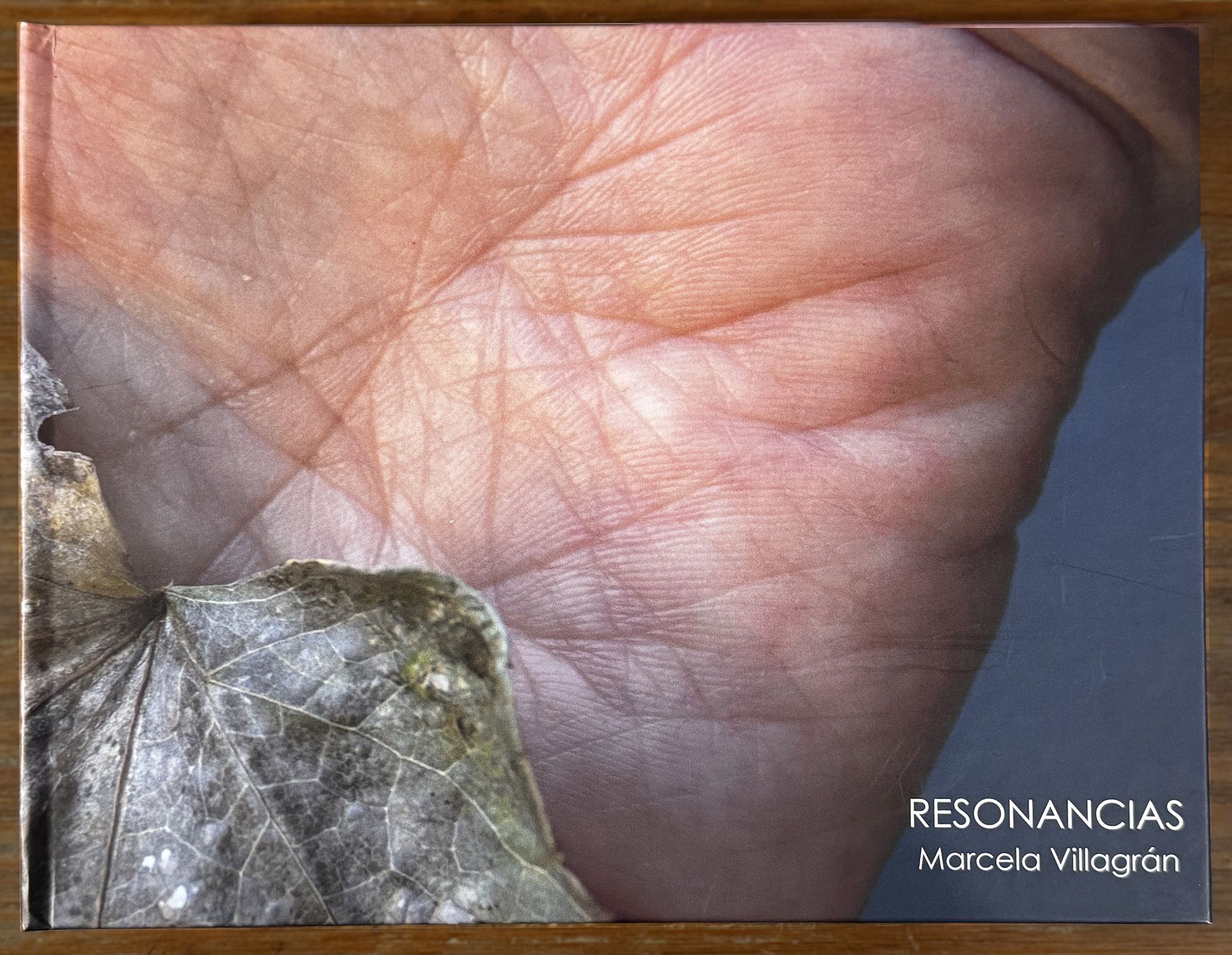
The Aroma is a photobook that invites you to delve into a poetics of relationships and dialogues of forms, colors and sensations.

  • 1
  • 2